Cleaning that starts when service stops
A restaurant can only be cleaned properly once the last table has gone and the burners are off. That is when our night team arrives. Chairs go up on the tables, the kitchen cools down, and every area is worked through in a fixed order, from the cleanest to the dirtiest.
A visit might start at 10.14 pm and finish at 3.08 am. The exact times depend on when you close, the size of the kitchen and what the checklist calls for that night. You give us a key, a badge or an alarm code; we lock up behind us, and our departure time appears in the report.
Every night we take care of the essentials. Once a week or once a month, depending on how busy you are, a longer visit tackles what daily cleaning cannot reach: underneath equipment, tiled walls, cold-room doors, light fittings and air vents.
The kitchen and the hood, station by station
The kitchen is the heart of the visit and the part that demands the most method. We work from top to bottom, and from food-contact surfaces down to the floor, so that nothing already cleaned gets dirty again.
On the hood, we remove and degrease the filters, then clean the canopy and every visible surface. Full degreasing of the extraction ducts is a separate trade, carried out by a specialist firm. We tell you so at the first visit, and we can work around their schedule if you wish.
- Worktops, shelving and stainless steel tables
- Range, plancha, oven and the outside of the fryers
- Hood filters removed and degreased
- Tiled walls behind the cooking line
- Dishwashing area, dishwasher and plate return
- Cold-room handles and door seals
- Kitchen bins emptied, washed and disinfected
- Tiled floors, skirting and floor drains
The dining room, the counter and the windows
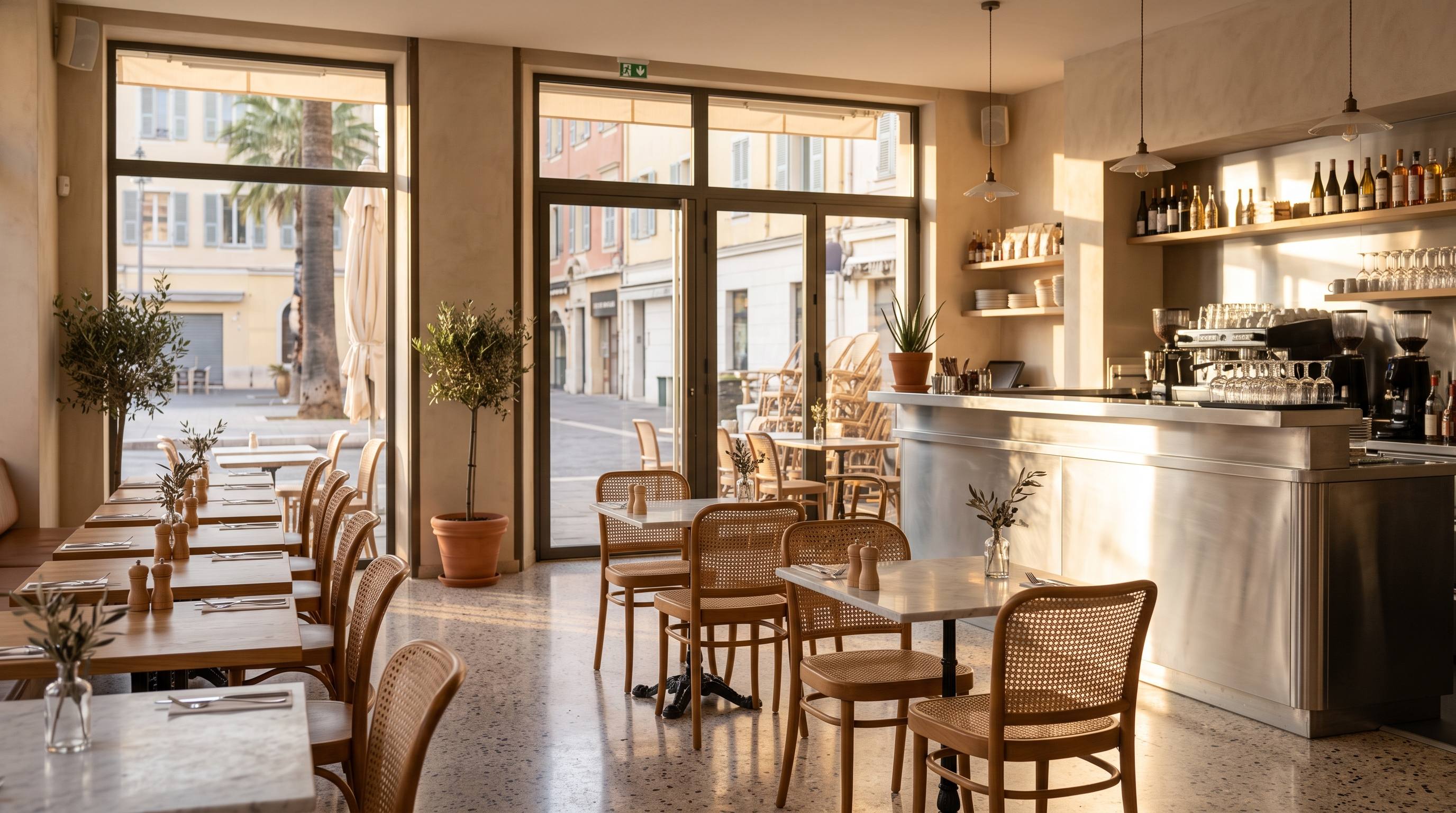
In the dining room, it is the details your guests notice: a sticky chair leg, a marked banquette, a window smeared with fingerprints. We go through them one by one, including tables, seating, the counter, laminated menus and ordering screens.
Close to the sea, shop windows dull quickly under salty air and street dust. Whether you are on the Promenade or in a side street in the centre, we clean the inside of the glass on every visit and, depending on access, the street side at an agreed frequency.
Terraces need their own routine: outdoor furniture, glass screens, planters, floors swept then washed, cigarette ends picked up. We leave them until the end of the visit, once the street has gone quiet and nobody is sitting outside.
Washrooms that match the dining room
Plenty of guests judge a restaurant by its toilets. Bowls, urinals, basins, mirrors and taps are descaled and disinfected, floors are washed right into the corners, and dispensers are checked.
Staff changing rooms and toilets follow the same checklist as the guest ones. When paper, soap or bin liners are running low, we note it in the report so the order goes out before you run out.
A washroom that is clean at 3 am still has to be clean at noon, so we also check flushes, seats and hand dryers, and we report anything that leaks or no longer works.
Routines built around food hygiene
Your food safety management plan remains yours, and so does responsibility for hygiene in your premises. Our job is to carry out the cleaning part you have defined, rigorously, and to keep a dated record you can show.
In practice, our routines follow a few simple, consistent principles, written down in black and white in your restaurant's checklist.
We do not present any certification on your behalf. What we bring is a method that does not change from one night to the next, and time-stamped proof of every visit.
- Cloths and buckets kept separate for each area: kitchen, dining room, washrooms
- Products suited to food-contact surfaces, rinsed where required
- No cleaning while food is being handled
- Your flow respected, always from clean to dirty
- Any issue photographed and reported during the visit
The Cleannproof report, on the manager's phone
Cleannproof is the software we built for our own teams. During the visit, each item on your checklist is ticked off and photos are taken on site. Arrival time, departure time and every check are recorded by our server, so nobody can change them afterwards.
The report goes to the manager as soon as the visit ends. A leak under the sink, a tired cold-room seal, a dead bulb in the dining room: you know before opening, with a photo. The history stays available, which helps with a hygiene inspection or a franchisor's audit.
If you run several sites, each restaurant has its own checklist and its own history. You can compare visit times and reported issues at a glance, site by site.
From quick service to the neighbourhood bistro
Wingstop trusts us with the cleaning of its restaurant in Nice. Quick service sets its own pace: high volumes, fryers, ordering kiosks, trays, and a dining room that has to look new every time the doors open.
We also work in very different settings: a small kitchen in the Old Town, where equipment is carried by hand through pedestrian lanes; a brasserie at the port with a large terrace; a lunch-focused spot near the Arenas business district. The checklist changes from one place to the next; the method does not.
Nice never really goes quiet, but summer, long weekends and event nights push up the number of covers. We plan reinforced visits in advance for those periods, so the kitchen starts clean again after a heavier service.
How we get started
We begin with a walk-through of the restaurant at a time that suits you, ideally with the person who closes up at night. We look at the kitchen, the hood, the dining room, the washrooms and the access points.
You then receive a checklist written for your premises and a quote. The first visit serves as the benchmark: you read the report, we fine-tune what needs fine-tuning, and the agreed rhythm settles in, every night or a few nights a week.
Our team leaves from Cannes and reaches Nice on the A8. We plan our rounds so that our arrival time at your door stays the same from one week to the next.
Sources: explorenicecotedazur.com